Posts

Weep 9: Article Summary " Building Library Community Through Social Media"
Image
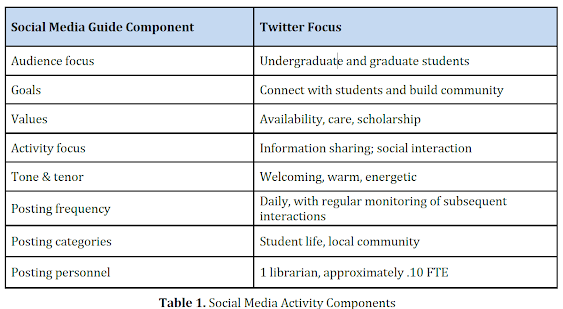
This paper details how an academic library leveraged Twitter to foster community. While existing literature predominantly addresses social media's marketing role, this research emphasizes its capacity for community-building. The university library formed a social media group and implemented a guide to cultivate a purposeful, engaging, and interactive online presence. Quantitative analysis revealed a significant rise in Twitter followers and interactions, highlighting social media's potential to strengthen the library's ties with academic communities. This study is pivotal for understanding social media's impact on academic libraries, particularly fostering user communities. Emphasizing strategy, personality, and interaction, the research provides practical guidance for libraries aiming to enhance their social media presence. Its detailed methodology and robust quantitative data make it an indispensable resource for libraries transitioning from traditional marketing ...

Week 9: Black Identity Development: Reflecting on Cross's Nigrescence Framework

This week, while writing a critical essay on Black identity development, I reflected on my experiences as a Brown female. I delved into Cross’s Nigrescence framework to understand the processes behind Black identity development, and through this exploration, I gained valuable insights. Cross's framework describes the five stages of Nigrescence, the process of becoming Black: Pre-Encounter, Encounter, Immersion-Emersion, Internalization, and Internalization-Commitment. These stages outline the psychological and social changes that Black individuals experience. The Five Stages of Nigrescence 1. Pre-Encounter: In this stage, Black individuals often internalize societal stereotypes and adopt assimilationist attitudes, believing that fitting into White norms is essential for success. This internalization can lead to feelings of self-hatred and a low sense of racial salience. Such Black students might see their lack of academic success as a personal failing rather than a consequ...

Week 7: Reflection and Faculty Support

Last week was quite stressful for me. As I shared in my blog, I must start preparing for my expected Prelims in January. Amidst this stress, a faculty member asked if I was okay. After our conversation, I felt immensely relieved and confident that I could ace the exam. This experience underscores the crucial role of faculty support in student success. I strongly advocate for this support, having personally contributed to students' academic and moral development in the past. Without such mentors, students often find themselves vulnerable, lacking the guidance and encouragement to navigate their academic journeys effectively.

Week 7: Male Privilege, Moral Corruption, and Women Hypocrisy

After watching the movie “12 Years a Slave”, how white owners exploit black female slaves sexually and how their wives did not blame their husbands and punish the black female slaves have made me think about the moral corruption of people with power.   The movie portrays the physical and psychological torture inflicted on slaves by their owners and how the slaves endured them. Slaves were treated as chattel property, deprived of their identities, and subjected to constant fear and violence. This objectification and dehumanization are starkly contrasted with the more subtle psychological torment, which probably left lasting scars on their psyche. The movie further highlights the unique struggles of enslaved women, highlighting the harsh conditions of their lives, their children being sold separately, and disregarding their cries and sufferings. Furthermore, young women were often sold at higher rates than older women, subjected to nudity, and slept with male slaves. These conditions...

Week 7: Multifunctional Female Body

  This week, I wrote a critical essay on “12 Years a Slave,” and I am still processing how a black female slave in the movie was treated. The film highlights the exploitation and suffering of Black women, the pervasive physical and psychological torture endured by slaves, and the deeply ingrained racial prejudices of the time. One of the most disturbing representations in the film is Patsey’, who embodies the collective suffering of all enslaved African American women. Patsey's character illustrates the severe physical and sexual violence inflicted upon Black women. She was not only subjected to harsh physical labor but also exploited for sexual pleasure by her owner. This dual exploitation highlights the multifaceted abuse of the Black female body, used for both physical labor and sexual pleasure, reflecting a broader societal view of slaves as mere objects rather than human beings. These dynamics highlight how race, gender, and free status intersect to compound the suffer...

Week 6 weekly Reflection

At this semester stage, I'm feeling exhausted and battling self-doubt. The upcoming prelims in the Spring require early preparation, which adds to my concerns. Balancing this with my regular coursework seems overwhelming, and I'm unsure how to handle it. Thoughts like "Will I manage?" persistently trouble me. I wish to have a break to prepare for my prelims with a free mind!  I wish I had 30 hours a day!  I wish I could manage stress, get long breaks to relax, and focus on upcoming exams!

Week 6 “Chapter 4: Networked Knowledge Activities”

Dennen's forthcoming chapter is well-crafted and comprehensively explains six knowledge activities: collecting, curating, sharing, brokering, negotiating, and constructing. The chapter also explores three supporting activities often associated with these knowledge processes: networking, tagging, and annotating. 1.     Collect: In an online context, collectors save and organize digital content by bookmarking web pages, favoriting or marking items on social media, or downloading media like PDFs, photos, and music to their computers. This collection can be purposeful and formal, such as gathering resources for a specific project, or more casual, such as saving items they find interesting for later use.    2.     Curate: Social media curation involves creating organized, annotated collections of online artifacts. This term, borrowed from museums, archives, and libraries, describes selectively building a collection to serve a specific p...